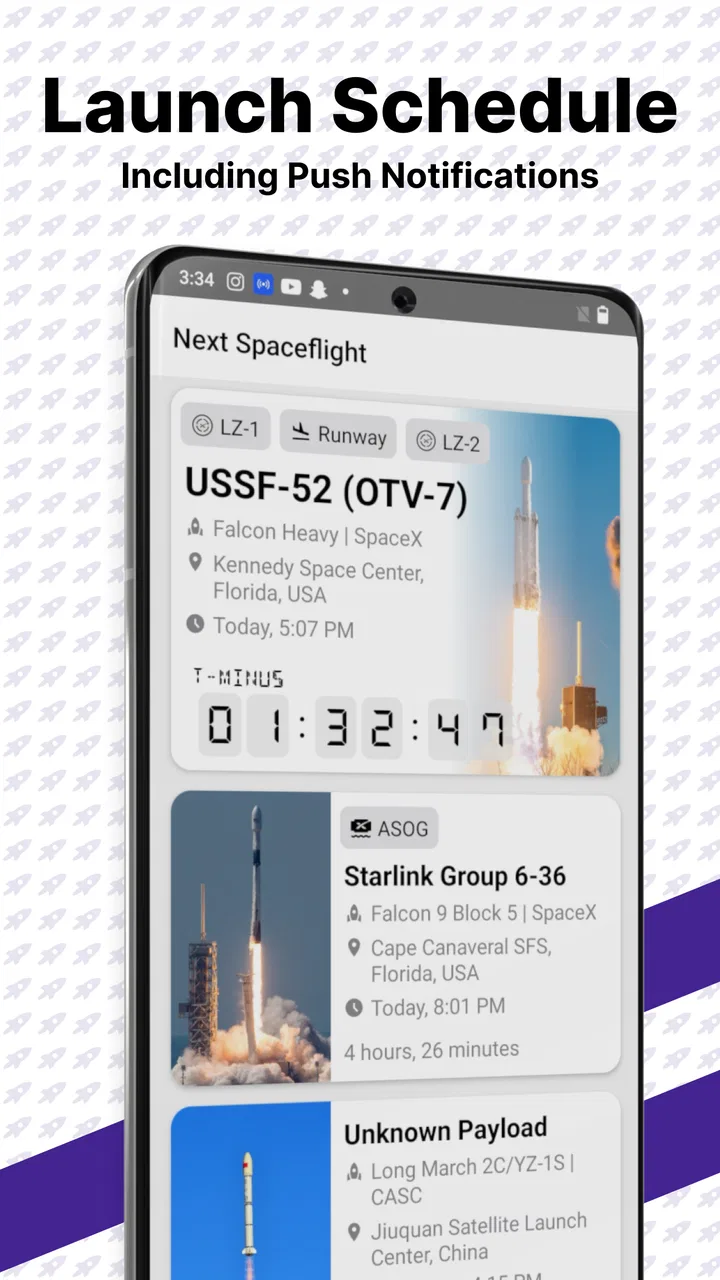
Next Spaceflight
- 4.8
- Rating
- 500.00K
- Installs
- Free
- Price

 Analysis by App-foxy
Following a launch schedule is easy when you only want to know whether a rocket is flying today. It becomes much harder when you care about changing target dates, different launch providers, international missions, and the difference between a planned event and a confirmed one. After spending time with Next Spaceflight, I found it most useful as a dedicated spaceflight calendar rather than as a general news reader. It puts the practical question—what is launching, and when—at the center.
The app is developed by NASASpaceflight LLC and sits in the News & Magazines category. It is free to use, carries an Everyone 10+ age rating, and has reached over 500,000 installs. Those details matter because the app’s appeal is not based on a subscription pitch or a one-time purchase. Its value comes from how much effort it saves when I want a reliable way to keep track of launches without rebuilding a calendar from scattered websites, social posts, and video channels.
What Next Spaceflight actually does well
The basic idea is focused: collect upcoming space launches into a schedule that covers NASA, SpaceX, ULA, Starship, ISRO, Roscosmos, and other programs. That range makes it more useful than an app built around one agency or one company. I can look at the next event that interests me, then use the same place to discover missions I might otherwise miss.
You May Also Like

 Blood Strike: 2.5 Anniversary
Blood Strike’s Loadouts Turn Every Drop Into a Tactical Gamble
A close look at Blood Strike’s custom loadouts: how fast access to signature weapons reshapes its battle royale rhythm, rewards preparation, and narrows the gap between fights.

 Pandora - Music & Podcasts
Pandora’s Music Is Easy to Start, but Harder to Recover
Pandora’s strength is its low-effort path from a seed to a station. Its weak spot is how much confidence it asks you to place in connection, setup, and quiet recovery.

 8 Ball Pool
 Is Built on Rivalries, Rematches, and Routine
A close look at the rivalries, rematches, shared routines, and unanswered safety questions that turn a quick pool match into a persistent mobile community.

 Samsung Music
’s Quiet Strength Is Playing What You Already Own
Its reach comes less from spectacle than from dependable access to a personal library. That simplicity is both the app’s strongest retention engine and its ceiling.

 AccuWeather: Weather Radar
AccuWeather Review: A Quick, Clear Forecast for Everyday Decisions
For everyday plans, the best forecast is the one you can understand quickly. AccuWeather makes rain timing, radar, and local conditions easy to act on, with a few trade-offs.

 Hill Climb Racing
Why Hill Climb Racing Still Turns Crashes Into One More Run
A tiny car, a bumpy hill and one more upgrade: Hill Climb Racing keeps resurfacing because its simple chaos makes every near-miss feel personal.
More From Our News Desk



I especially like that the schedule encourages a different way of following spaceflight. Instead of waiting for a headline after a launch is already widely discussed, I can browse forward and see the rhythm of planned missions. That is valuable for deciding which events deserve a reminder, a live-stream search, or a place on my personal calendar.
The app’s current version is 4.3.0, and it runs on Android from version 6.0 onward. That broad compatibility makes it practical for people who keep an older phone as a bedside device or a dedicated viewing screen. I tested it with the mindset of someone checking a launch during an ordinary day, not someone studying orbital mechanics, and the schedule-first design was immediately understandable.
A calendar for people who care about timing
Rocket launches are unusually difficult to plan around. Weather, technical checks, range availability, and vehicle readiness can all move an event. A schedule app therefore has to be treated as a living planning tool, not a promise that a rocket will leave at one exact moment. Next Spaceflight makes sense for that reality because its central purpose is to show the current launch outlook rather than bury it beneath long articles.
My favorite use is a quick morning check. I can scan the upcoming list, notice whether a mission is approaching, and decide whether I need to investigate the launch window later. This is more efficient than opening several news sites, searching each provider separately, and trying to compare time zones manually in my head.
It also works well for casual discovery. Someone may open the app because of a familiar SpaceX mission and then notice launches connected with other organizations. That broader view is one of the strongest reasons to choose it over a provider-specific application. The schedule becomes a map of the launch industry, not just a feed for one brand.
How I would use it before a launch
My practical workflow is simple. First, I browse the upcoming schedule and identify the mission that matters to me. Then I check its details close to the event, because an early target date should never be treated as final. Finally, I use the app as the starting point for the live coverage or official information I want at launch time.
That last step is important. A schedule is excellent for orientation, but it is not automatically a complete viewing guide. If I need a precise broadcast link, technical briefing, or detailed post-launch analysis, I would still use the relevant official channel or a specialist news source. Next Spaceflight reduces the search, but it does not replace every other space resource.
A useful habit is to check the schedule again shortly before making plans around a mission. This avoids one of the most common mistakes in spaceflight tracking: assuming that a date seen earlier in the week is still current. The app is most valuable when I treat it as a quick status reference and combine it with a little common sense about launch uncertainty.
Useful beyond major American launches
Many space apps feel comprehensive until I look for missions outside the most visible American programs. Here, the inclusion of ISRO, Roscosmos, and other launch activity gives the calendar a wider perspective. That matters to students, enthusiasts, and viewers who want to understand spaceflight as a global activity rather than a single-company story.
This wider coverage also creates a good learning workflow. I can use a familiar mission as an anchor, then explore nearby entries from organizations I follow less closely. Over time, the schedule helps me notice patterns in launch cadence and program activity without requiring a separate research project for every agency.
There is a trade-off, though. A broad calendar can feel dense if I only care about one provider. Someone who wants nothing except a particular company’s launches may prefer an official app, a focused newsletter, or a simple social feed. The strength of Next Spaceflight is breadth; that same breadth can be unnecessary for a narrowly defined interest.
What the rating and adoption suggest
The app holds a 4.8 average from around 16,000 ratings, alongside roughly 2,200 written reviews. I do not treat those figures as proof that every user will enjoy it, but they do match my impression that the app solves a clear problem for a committed audience. Its popularity appears understandable: launch schedules are fragmented, constantly changing, and difficult to follow casually.
The audience is not limited to experts. A newcomer can use the app simply to answer “what is launching next?” without knowing the difference between every rocket family or mission type. At the same time, an enthusiast can turn that same list into a regular tracking routine. That combination of approachable purpose and specialist subject matter is a real advantage.
Where the free value is strongest—and where it stops
There is no purchase decision to make before trying it: Next Spaceflight is free. That makes the evaluation straightforward. I am not judging whether a subscription is worth a monthly fee or whether a paid upgrade justifies its cost. I am judging whether the free access delivers enough usefulness to deserve a place on a phone, and in my experience it does for anyone who actively follows launches.
The free model is particularly valuable for occasional viewers. If I only watch a few launches each month, paying for a specialized service would be difficult to justify. Here, I can keep a launch calendar available and return when a mission becomes interesting. The app earns its space through convenience rather than through a premium purchase barrier.
For more serious followers, the value comes from repetition. Each individual schedule entry may answer only one small question, but the accumulated benefit of having a consistent calendar is substantial. I spend less time checking separate sources and less time wondering whether I have overlooked a mission from a program I do not follow every day.
Still, “free” should not be confused with “everything I need for launch day.” I would not choose it as my only source for deep reporting, engineering explanations, or official operational updates. Its value is strongest as a launch-tracking layer. If that is the exact problem I want solved, the price is excellent. If I want a full editorial publication, I should look elsewhere or use it alongside one.
Small details that improve the workflow
One non-obvious benefit is the way a schedule changes how I use news. Instead of reacting to whichever launch appears in my feed, I can start with the calendar and then seek context for the missions that matter. That reverses the usual order and makes my reading more deliberate. I am less likely to confuse media attention with actual importance to my own interests.
Another useful approach is to use the app as a planning filter for family or group viewing. If friends want to watch a launch together, I can first identify the likely event, then verify the latest timing before arranging a call or setting aside an evening. The app does not eliminate postponements, but it makes the initial coordination much less chaotic.
A third insight is that the broad provider coverage can expose gaps in personal knowledge. I may recognize a rocket immediately but not know much about the organization behind another mission. Seeing both in one schedule gives me a reason to investigate, which makes the app more educational than a simple countdown widget. The learning comes from the connections the calendar reveals.
I also recommend keeping expectations realistic around dates. A launch schedule is best used in stages: browse early, monitor as the event approaches, and confirm again before watching. That three-step habit protects against disappointment and is more useful than treating any calendar entry as an appointment guaranteed by the app.
Where it can feel limited
The focused design may disappoint readers who expect a traditional magazine experience. If I want long-form reporting, interviews, opinion pieces, or a constant stream of space-industry stories, a news publication will feel richer. Next Spaceflight is more like a working reference than a newspaper, and that distinction should guide the download decision.
There is also a natural limit to what any launch calendar can communicate. A date and mission listing can tell me what is planned, but it cannot make an uncertain launch certain. I still need to pay attention to updates, especially when a mission is important enough to organize my schedule around. The app is convenient, not magical.
People who dislike specialized interfaces may also find the subject matter too narrow. The app is not trying to help with general headlines, weather, sports, or broad technology news. Its usefulness depends almost entirely on whether spaceflight schedules are something I genuinely want to follow. For everyone else, the app may become an unused icon after the initial curiosity fades.
Who should install it?
I would recommend it first to space enthusiasts who follow more than one launch provider. The combination of SpaceX, NASA, ULA, Starship, ISRO, Roscosmos, and additional programs makes it a strong central reference. It is also a good fit for students, science communicators, teachers, and families who want a simple way to discover upcoming missions.
It suits occasional viewers better than many specialized services because the free access removes the pressure to use it every day. I can check it only when a launch catches my attention and still get worthwhile utility. That flexibility is one of the clearest reasons I would suggest trying it before searching for a more elaborate alternative.
I would be more cautious recommending it to someone who follows only one organization and already uses that organization’s official updates. In that situation, the wider schedule may add clutter rather than value. I would also steer a reader toward a dedicated space publication if their main goal is analysis, breaking news, or detailed mission background rather than timing.
For an older Android phone, the minimum requirement of Android 6.0 is reassuring, although the real experience will still depend on the device. The Everyone 10+ rating also makes it reasonable for many younger space fans, while parents can decide whether the app’s news-oriented content fits their child’s interests and maturity.
My final decision
After using it as a launch planner, discovery tool, and starting point for viewing research, I see Next Spaceflight as one of those apps that does one job clearly enough to become a habit. It does not need to be a full news outlet to be valuable. Its purpose is to make the scattered world of rocket launches easier to scan, compare, and revisit.
The free price makes the decision low-risk, and the broad schedule gives it more reach than a single-provider tracker. I appreciate that it helps me plan without pretending that launch dates are immovable. That balance—useful organization paired with the need for final confirmation—is exactly how I want a launch calendar to behave.
My recommendation is to install it if you regularly ask what is launching next, especially if your interests cross national agencies and commercial providers. Use it as the calendar layer in a larger spaceflight routine, then turn to official sources for final timing and live coverage. Skip it if you want general space journalism or only need one company’s announcements.
With a 4.8 average and around 16,000 ratings, it clearly resonates with a substantial enthusiast audience, but its real test is personal: does a shared launch calendar save you time? For me, it does. The best reason to choose it is not the novelty of watching rockets; it is the practical clarity it brings to an unpredictable schedule.
FAQs for Next Spaceflight
01What is Next Spaceflight and what are its primary features?
Next Spaceflight is an app designed for space enthusiasts, providing up-to-date information on upcoming rocket launches. Key features include detailed launch schedules, notifications for events, live streaming options, and a comprehensive database of past launches. It also offers news updates and articles about space missions and technology.
02Is Next Spaceflight available on both Android and iOS platforms?
Yes, Next Spaceflight is available for download on both Android and iOS devices. This ensures that users from either platform can access the latest space launch schedules, news, and live coverage. The app is optimized for both operating systems to provide a seamless user experience.
03How accurate is the information provided by Next Spaceflight?
Next Spaceflight is known for its reliable and accurate information, sourced from official space agencies and reputable news outlets. The app is frequently updated to ensure users receive the latest data on launch schedules and space-related news. However, as with any app, it's advisable to cross-reference information if critical.
04Does Next Spaceflight offer notifications for upcoming launches?
Yes, Next Spaceflight provides customizable notifications for upcoming rocket launches. Users can set alerts to stay informed about specific launches or events. This feature ensures that you never miss an important space mission, making it perfect for enthusiasts who want to stay connected to the latest happenings in space exploration.
05Is there a cost associated with using Next Spaceflight?
Next Spaceflight is free to download and use, offering a wide range of features at no cost. However, it may include optional in-app purchases or ads. Users who wish to support the developers or access additional features can consider these options, but they are not necessary for the app's primary functions.
Pros
- Real-time launch updates for enthusiasts.
- Extensive rocket and mission details.
- User-friendly interface with intuitive design.
- Customizable notifications for upcoming events.
- In-depth articles and space news coverage.
Cons
- Limited offline functionality.
- Occasional notification delays.
- Ads can be intrusive at times.
- No option for dark mode.
- Requires frequent updates for accuracy.

Next Spaceflight
Gallery